
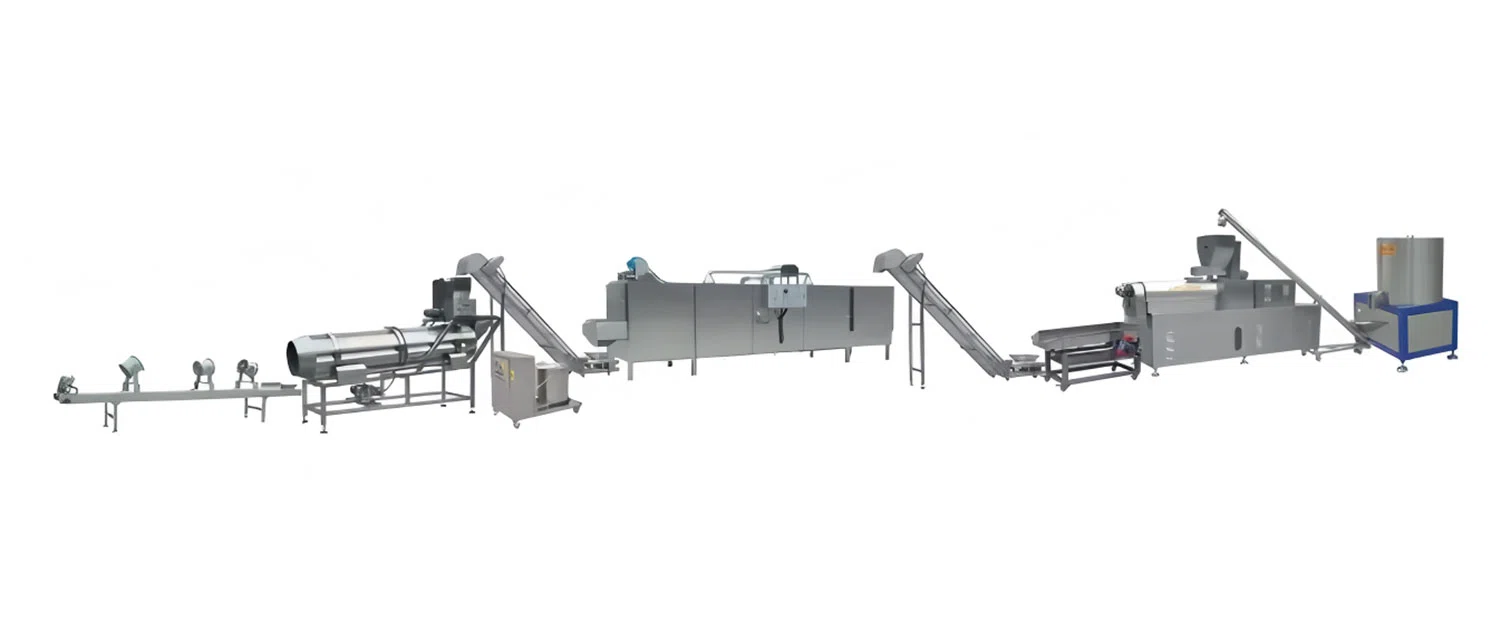
Choosing a puffed snack production line is not simply a matter of selecting the largest kg/h figure in a catalog. The right capacity must match your target snack, raw material, working schedule, downstream process and expected sales volume. A line that is too small can restrict growth, while an oversized line can leave utilities, labor and downstream equipment underused.
This guide explains how to compare Zhuoheng ZH65, ZH70, ZH85 and ZH95 complete-line capacity references and how to turn a sales target into a practical equipment discussion.
Quick comparison of puffed snack line models
The following figures are complete-line catalog references. Installed line power and estimated consumption are different measurements; they should not be confused with the power of the main extruder alone.
| Model | Reference capacity | Installed power | Reference consumption | Typical project direction |
|---|---|---|---|---|
| ZH65 | 120–150 kg/h | 89 kW | 53 kW | Entry commercial production |
| ZH70 | 200–250 kg/h | 126 kW | 75 kW | Growing regional supply |
| ZH85 | 400–500 kg/h | 191 kW | 114 kW | Established industrial factory |
| ZH95 | 800–1,200 kg/h | 289 kW | 173 kW | High-volume manufacturing |
Capacity is a reference range, not a guaranteed output for every product. Final throughput depends on raw material, formula, snack shape, expansion ratio, equipment configuration and operating conditions.
You can also review the current specifications on the puffed snack production line model comparison page.
Start with required daily output
Before choosing a machine, define how much sellable product you expect to produce per day. Then divide that target by the number of net production hours—not simply the total hours that the factory is open.
For example, a target of 1,600 kg per day over eight net production hours equals an average requirement of 200 kg/h. Net production time should reflect startup, cleaning, product changes, inspections and planned stops. This calculation provides a useful starting point, but it does not replace a product test or a complete line assessment.
Also consider whether the target is for the first year or for a later growth stage. A project designed only around the initial sales forecast may require an early upgrade. A project designed around an unrealistic future target may tie up budget and factory space before the market is ready.
Five factors that change practical capacity
1. Raw material and formula
Corn flour, rice flour, wheat flour and starch blends do not behave identically during extrusion. Moisture, particle size, starch characteristics and added ingredients affect feeding stability, cooking and expansion. Two products made on the same extruder can therefore have different practical outputs.
2. Snack shape and expansion ratio
Rings, balls, curls, sticks and other direct-expanded shapes use different dies and cutting conditions. A dense product and a highly expanded product should not be compared only by finished volume. Confirm whether your target is measured by mass, package count or finished product volume.
3. Drying or frying route
The extrusion section is only one part of the line. The product may require drying, frying, oil spraying, seasoning and cooling before packaging. The chosen route affects residence time, heat demand, floor space and the capacity required from downstream equipment. See the puffed snack applications page for common process directions.
4. Working hours and product changeovers
A factory running one product for long campaigns has a different capacity profile from a factory changing shapes and flavors several times per shift. Frequent die changes, cleaning and seasoning changes reduce net production time. Build the schedule around realistic operation rather than theoretical continuous running.
5. Packaging and material handling
A fast extruder cannot compensate for undersized drying, seasoning, cooling or packaging equipment. Finished snacks can accumulate if the downstream system is not balanced. The complete project should therefore be evaluated from raw-material preparation to finished-pack handling.
How the four models fit different project stages
ZH65: a practical commercial starting point
The ZH65 reference range of 120–150 kg/h can suit a new commercial operation, a focused product range or a market that is still developing. It may also be appropriate when factory space or available electrical capacity is limited. The final decision should still consider required daily output and the full downstream process.
ZH70: room for regional growth
At a reference range of 200–250 kg/h, the ZH70 can serve projects that need more output than an entry line while remaining below a large industrial configuration. It is often the model worth comparing when the business expects multiple distributors, more working hours or a broader product range.
ZH85: established industrial production
The ZH85 reference range is 400–500 kg/h. At this stage, factory planning becomes increasingly important: utilities, raw-material supply, drying capacity, seasoning consistency, cooling and packaging must all be designed for the intended production schedule.
ZH95: high-volume manufacturing
The ZH95 reference range of 800–1,200 kg/h is intended for high-volume projects. It requires a corresponding plan for material storage, utilities, downstream equipment, finished-product handling and maintenance. A high-output line should be selected only when the market plan and factory infrastructure support it.
Common capacity-selection mistakes
- Choosing by maximum output alone: the highest catalog figure may not match your product or formula.
- Comparing only the main extruder: complete-line power and scope are different from main-machine specifications.
- Ignoring the dryer or fryer: downstream residence time can determine the practical output of the complete line.
- Using total shift hours as production hours: cleaning, startup and product changes reduce net running time.
- Comparing incomplete quotations: check whether mixing, feeding, drying or frying, seasoning, cooling and controls are included.
- Forgetting packaging: the packaging system must handle the finished snack volume and bag format.
Information to prepare before requesting a recommendation
A useful technical discussion can begin with seven items:
- Photos or samples of the target snack.
- Required finished-product capacity in kg/h or kg/day.
- Available raw materials and any existing formula.
- Preferred snack shape, dimensions and texture.
- Drying, frying and seasoning requirements.
- Local voltage, frequency, phase and preferred heat source.
- Workshop dimensions and whether packaging is included in the project.
With this information, the supplier can compare the required process with the model range and identify questions that need sample testing or further confirmation.
Choose the complete process, not only the extruder
The best puffed snack production line is the one that can repeatedly make your intended product at a practical output while fitting your utilities, workshop and operating plan. Start with the finished snack and daily sales target, work backward through packaging and downstream processing, and then select the extrusion model.
If you are comparing ZH65, ZH70, ZH85 or ZH95, send Zhuoheng your target snack, capacity and factory requirements. The technical team can help organize the information needed for a line recommendation and project-level confirmation.
Planning a puffed snack project?
Share a product photo and your target output. We will recommend a practical line configuration for evaluation.