
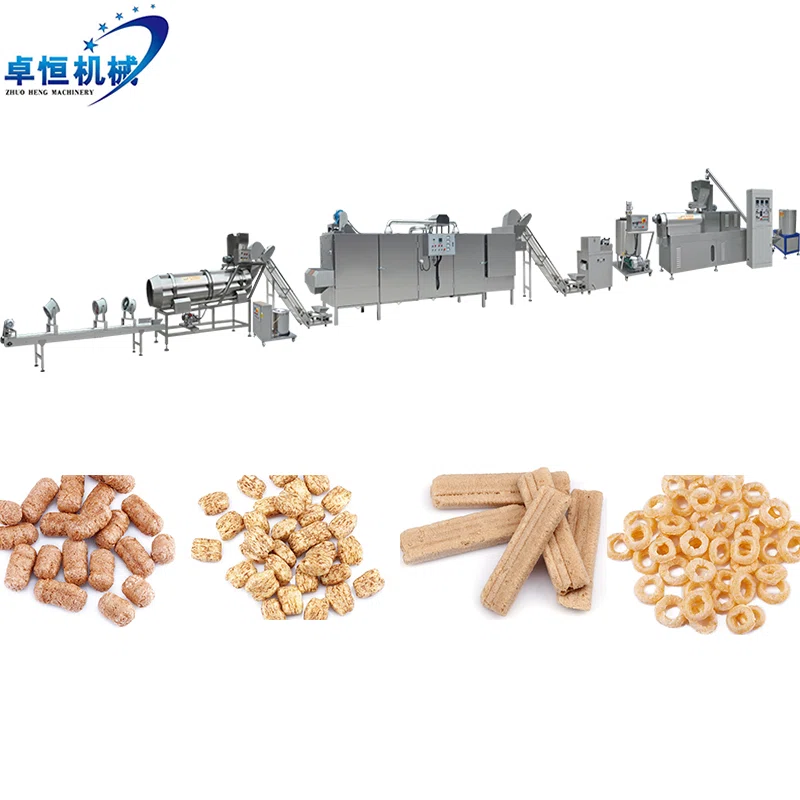
Round shape begins at the die and cutter
Cheese balls are generally produced as direct-expanded corn snacks. The extruded material expands as it leaves the die and is cut at the die face. The relationship between formula, die opening, cutter speed and process pressure determines whether the result approaches the target diameter and roundness.
“Cheese ball” describes the finished flavor as well as the shape. The base puff is normally dried first, then receives oil and cheese powder in a coating or flavoring system. Seasoning equipment must distribute powder evenly without damaging the lightweight pieces.
Production stages to confirm
- Controlled mixing and moisture addition for repeatable extrusion.
- Twin-screw cooking and expansion for the required internal cell structure.
- Die-face cutting for ball size and shape direction.
- Hot-air drying for final moisture and crispness.
- Oil application and cheese seasoning, followed by cooling and packaging.
Why a sample matters
Ball diameter alone is not enough. The engineering review should also know the required density, surface smoothness, crispness, color and seasoning load. A very light ball occupies more conveyor, dryer and package volume than a denser product at the same kg/h. Formula testing may be required when the raw material or target texture differs from an existing reference.
Match the line size to sellable output
Evaluate ZH65 for 120–150 kg/h reference capacity or ZH70 for 200–250 kg/h. Established industrial projects can compare ZH85 at 400–500 kg/h and ZH95 at 800–1,200 kg/h. Packaging speed should be calculated from bag weight and bags per minute, not assumed from extruder capacity alone.
For long or curled products, see the corn puff sticks page. For ring-shaped cereal products, review the cereal rings process.