
A ring is a combined formula and tooling result
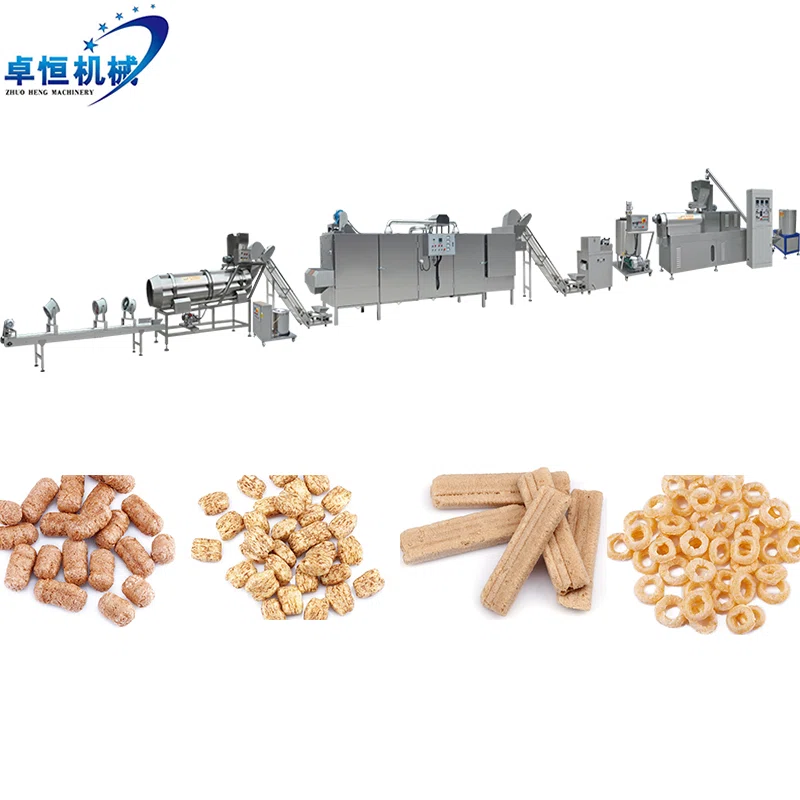
Cereal rings can be produced by direct expansion from corn, rice or blended cereal flours. The material is mixed and fed into a twin-screw extruder, cooked under controlled conditions and shaped through a ring-profile die. Cutting, drying and optional coating complete the product route.
The hollow profile makes ring stability important. The opening can close, the wall can expand unevenly or the ring can deform when the material flow, formula or cutter does not match the die. For this reason, a reference sample and target dimensions are more useful than the phrase “cereal ring” alone.
Raw material changes the process window
Corn flour, rice flour and mixed grains do not expand in exactly the same way. Starch behavior, particle size, protein, fiber and initial moisture influence pressure, cell structure and color. Sweetened or coated breakfast-style rings may also require a different downstream treatment from savory rings.
Typical direct-expansion route
- Blend dry ingredients and add controlled moisture.
- Feed consistently into the twin-screw extruder.
- Cook, expand and form the hollow ring through the selected die.
- Cut and convey without crushing or excessive deformation.
- Dry to the target moisture, then coat, cool and package as required.
Capacity and downstream sizing
Zhuoheng’s reference model range covers 120–150 kg/h with ZH65, 200–250 kg/h with ZH70, 400–500 kg/h with ZH85 and 800–1,200 kg/h with ZH95. Actual cereal-ring output depends on the formula, ring profile, expansion and dryer load. Bulky products also require enough cooling and packaging volume.
Compare cheese balls when the target is a round die-face-cut puff, or corn puff sticks when length control is the main shaping requirement.