
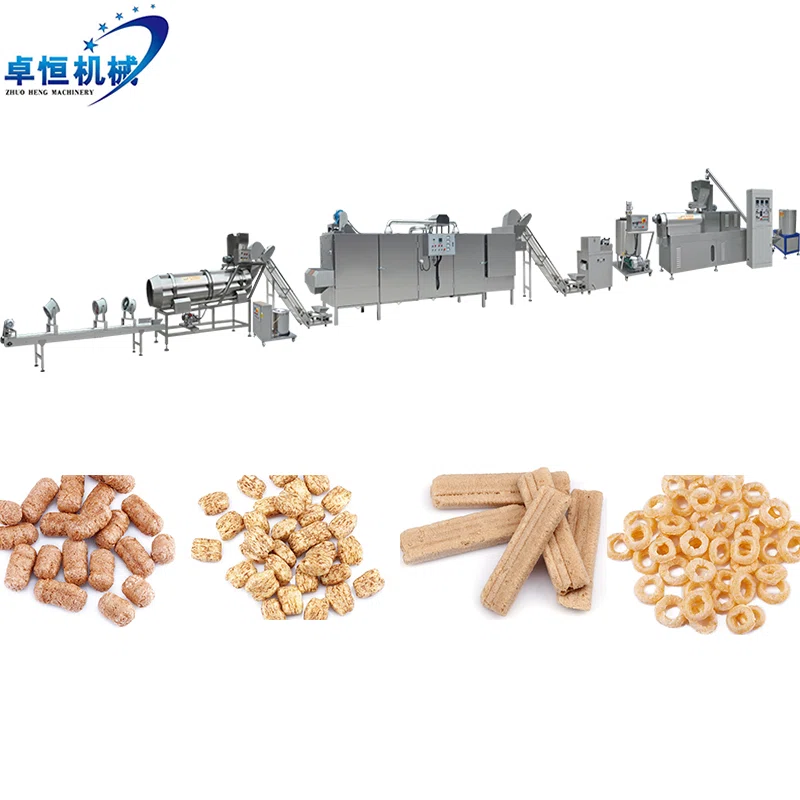
Frying changes the complete production route
Some puffed or formed snacks require oil frying to develop their final expansion, texture and flavor. This is not the same downstream process as a standard direct-expanded corn puff that leaves the extruder expanded and then passes through hot-air drying. The product must be identified first so the forming, conditioning and fryer sections can be configured correctly.
The phrase “fried puffed snack” can refer to different structures. Some products are formed before frying; some are pellet-based and need a separate pellet production stage; others use an extrusion route followed by frying. Photos, dimensions, cross-section and a physical sample help distinguish these processes.
Typical frying-side modules
- Raw-material mixing and the appropriate forming or extrusion section.
- Product conveying or conditioning before frying, where required.
- Controlled frying with suitable residence time and oil temperature.
- De-oiling and product transfer after the fryer.
- Seasoning, cooling and packaging matched to the fragile finished snack.
Do not confuse direct puffs with snack pellets
Two products can look similar on the shelf but use different manufacturing logic. A 2D or 3D snack pellet is normally formed and dried as an intermediate product, then puffed or fried later. That requires a separately configured pellet line and should not be quoted as a simple mold change on a direct-expanded puff line.
What determines fryer and line size
Required kg/h is only one input. Product moisture, piece size, residence time, oil pickup, de-oiling target and seasoning load influence the fryer and downstream capacity. Oil management, ventilation, cleaning access and local factory requirements also need project review.
If your target is a dry direct-expanded snack, compare the corn puff stick, cheese ball and cereal ring routes instead. The standard ZH65–ZH95 model table is a useful reference, but a fried process must be sized after the sample route is confirmed.